
The safety of patients primarily relies on more than just simple clinical expertise. Hospitals further require structured procedures to recognize risks, actively report incidents, monitor compliance, and take corrective action. This is exactly where a digital Quality Management System can drive a measurable difference.
At MedQPro, we actively bring in quality workflows followed by corresponding incident reporting, audits, accreditation, and risk management into one core platform while assisting healthcare organizations to build up a more consistent level of approach to foster patient safety.
Table of Contents
- How does QMS reduce medical errors in hospitals?
- How does incident reporting improve patient safety?
- How does QMS support NABH/JCI accreditation?
- What QMS capabilities improve patient safety in real time?
How does QMS reduce medical errors in hospitals?
Likewise, with MedQPro, hospitals can proactively digitize quality-related workflows and improve visibility across departments to minimize the risk of variability in processes, limited access to information, and inadequate incident analysis in medical services. A hospital QMS aids in developing a comprehensive system of identifying weaknesses and corrective actions.
Audit findings, incident information, and quality indicators can thus be monitored in a systematic manner, reducing reliance on disconnected ranges of spreadsheets, documents, or manual follow-ups.
For hospitals that are managing medical staff compliance, core complementary systems such as Hospital Credentialing Management Software, Healthcare Provider Privileging Software, and Medical Staff Credentialing Solutions can further assist in maintaining an accurate set of information about the provider privileges and qualifications.
Be that as it may, a digital quality framework can thus support:
- A well-established incident reporting and investigation system is in place
- Corrective action log and tracking of corrective and preventive actions
- A system for monitoring quality indicators
- To plan and follow up on an audit
- Ensure that the documentation and control of the SOP are carried out
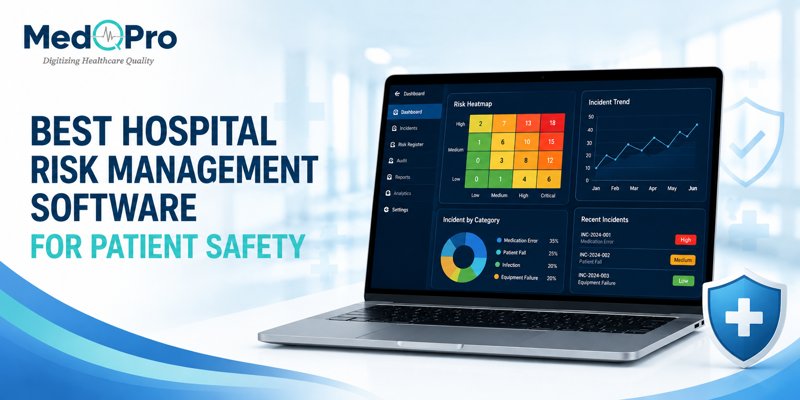
- Safety and risk assessment
- Planned and pretested the closure of a mock drill
This establishes a more traceable quality environment, where teams can discover regular issues and react before it becomes worse.
How does incident reporting improve patient safety?
Incident reporting stands of higher value wherein at MedQPro, we assist in digitizing the incident reporting so that healthcare teams can actively report events and manage subsequent levels of workflows in a more systematic manner. Furthermore, mobile functionality also enables the pertinent authorized users to actively report, investigate, and assess the incidents away from their core desks, including offline when connectivity is unavailable.
This approach can further assist the respective quality teams to recognize patterns across incidents in place of treating every incident as an isolated occurrence.
Thus, for the organizations that are managing healthcare professionals, Physician Credentialing and Compliance Software and Automated Provider Credential Verification System can further actively strengthen administrative compliance by thoroughly assisting the verification and core monitoring of provider information.
How does QMS support NABH/JCI accreditation?
At MedQPro, we are being built with a focus on JCI and NABH accreditation requirements, to help hospitals digitize quality workflows and to maintain or visit accreditation-based activities through an integrated platform.
Hospitals are required to show evidence of quality and safety processes through accreditation tasks, which demonstrate that they are implemented consistently, documented, and monitored. Requirements may be complex and become difficult to manage manually when the quantity of departments, documents, audits, and quality indicators grows.
It functions as a document management system, audit management, quality indicator management, medical record compliance, incident reporting, and risk or mock drill management. If a hospital is looking for a more connected solution, the hospital provider credentialing software can also be used as a complementary solution to quality management, enabling necessary provider information to be stored in a structured manner, in addition to compliance.
This results in a more structured environment to prepare the evidence, track compliance, and ensure that quality activities are observed throughout the accreditation process.
What QMS capabilities improve patient safety in real time?
At MedQPro, all multiple quality and accreditation workflows are integrated into one platform, providing hospitals with a single platform where they can manage the workflow of key activities.
Here are the vital functions that altogether contribute in improvising the patient safety in real time:
- Incident Reporting Management: Helps in reporting, examining, and tracking incidents.
- Quality Indicator Management: Assists the hospital in gathering and analyzing the specified quality indicators and understanding the trends.
- Safety and Risk Management: Helps in finding, estimating, and reducing risk.
- Medical Record Compliance Management: Aids professionals in medical record compliance in executing compliance activities.
- Policy and SOP Management: Records policies and SOPs throughout their lifetime.
- Dealing with Quality Assurance Studies and Audit-Related Actions: Arranges the audit activities and leads.
- Mock Drill Management: Provides support for planning, running, and closing mock drills.
- Mobile Access: Access reporting, investigation, and management from off-screen.
For healthcare organizations with complex quality programs and employer requirements, automated physician credentialing software can also be a solution when the time and resources required for the physician credentialing and compliance process are growing too high.
Digitise Your Hospital’s Quality Journey
At MedQPro, we actively assist in moving beyond fragmented quality processes with an integrated digital platform that is being actively built around core accreditation, compliance, and subsequent patient safety.
Starting from core incident reporting and risk management to audits, documentation, and quality indicators, the platform further assists the quality champions in bringing in critical workflows altogether. Contact MedQPro to begin your journey towards smart-based quality management. Empower your team and make patient safety a continued priority.
FAQs
Who needs to be part of a QMS implementation in hospitals?
To make sure the implementation of QMS goes smoothly, one will have to involve quality teams, hospital administration, clinical leaders, as well as IT specialists. The involvement of end users would also guarantee a practical workflow means that they’ll get a clear picture of how the system works.
How long do hospitals need to implement hospital QMS software?
The implementation period depends on hospital size, number of departments, modules chosen for the system, workflows already existing in each hospital, and data needed to run the system. It may be easier to implement QMS by introducing key features of the system step by step.
What are the ways hospitals can measure QMS effectiveness?
The effectiveness of QMS can be measured by the completion of various audits, closing corrective actions, measuring incidents, compliance preceding events, and preparing reports before accreditation. In fact, the indicators of effectiveness should meet the standards of the organization.