
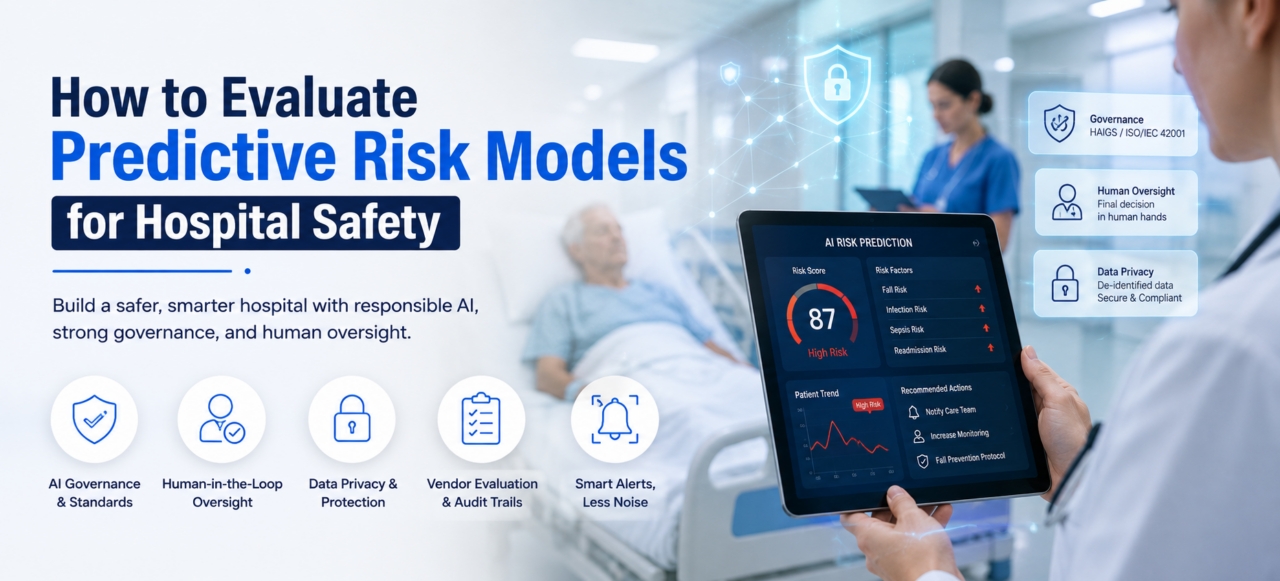
Buying new software that guesses which patient might fall out of bed sounds great until the machine makes a bad call and someone gets hurt. Hospital compliance officers must test these new predictive engines heavily before bringing them onto the ward. You need a rock-solid plan to judge if a digital tool actually spots real danger or just creates loud, useless alarms that annoy your nursing staff.
Table of Contents
- What is the HAIGS or ISO/IEC 42001 framework and how do hospitals use it to evaluate AI risk management software?
- How do hospitals build human-in-the-loop checkpoints to limit clinician legal liability when using AI predictive risk models?
- How does hospital QMS software prevent AI models from memorizing or leaking sensitive patient data?
- Is there an AI governance checklist or audit trail template hospitals can use to evaluate predictive risk software vendors?
- How can hospitals implement AI risk scoring without adding to clinician alert fatigue or disrupting existing workflows?
What is the HAIGS or ISO/IEC 42001 framework and how do hospitals use it to evaluate AI risk management software?
MedQPro aligns its reporting tools with the HAIGS and ISO/IEC 42001 framework guidelines to help hospitals map out how they evaluate new AI risk management software before purchase. You use these rulebooks as a grading scale to see if a vendor builds safe code.
These global standards force developers to show exactly how their machine decides a patient is in danger. If a software company cannot hand you a document explaining their math or showing their privacy firewalls, you throw their application out. Buying unverified code leaves your hospital open to heavy lawsuits if the program ignores a dying patient.
How do hospitals build human-in-the-loop checkpoints to limit clinician legal liability when using AI predictive risk models?
MedQPro builds human-in-the-loop checkpoints directly into your existing workflow by forcing a real doctor to sign off on any action suggested by the machine, limiting clinician legal liability. The software never sends a patient to surgery by itself.
- Review buttons: A nurse must click “approve” on a machine-generated fall warning before the chart updates.
- Override logs: If a doctor disagrees with the computer, they type their own medical reasoning into a locked text box.
- Final say: The machine acts as an advisor, keeping the ultimate legal responsibility firmly in human hands.
How does hospital QMS software prevent AI models from memorizing or leaking sensitive patient data?
MedQPro protects your wards from data leaks by scrubbing all names and identifying details from the charts before any predictive engine looks at the files. Good hospital AI governance requires breaking the link between a medical danger score and a patient’s real identity.
“A secure system feeds the machine pure numbers like blood pressure drops and fever spikes while locking the actual patient name behind a separate, encrypted firewall.”
This setup ensures that even if a hacker breaches the outer shell of the predictive tool, they only find anonymous vital signs. Your quality team gets the hazard warnings without violating HIPAA or local privacy laws.
Is there an AI governance checklist or audit trail template hospitals can use to evaluate predictive risk software vendors?
MedQPro provides built-in audit trail templates that let you grade predictive risk software vendors on their safety features, bias testing, and data handling before you sign a contract. You load this checklist into your automated risk register to track every vendor’s weak spots.
| Vendor Check | What to Ask | Red Flag Warning |
| Data Source | Where did you train your code? | Only used data from a single, wealthy hospital. |
| Bias Testing | Does this work for all races? | Cannot prove testing on diverse local populations. |
| Update Cycle | How often do you fix bugs? | The code has not changed in over a year. |
How can hospitals implement AI risk scoring without adding to clinician alert fatigue or disrupting existing workflows?
MedQPro stops clinician alert fatigue by silencing low-level warnings and only pushing high-threat notifications to the specific nurse working the affected bed. Smart scoring is about reducing noise, not setting off alarms all over the floor.
- Filter out minor movements like a patient shifting a blanket.
- Push life-threatening alerts straight to a mobile device.
- Automatically mute the warning once a doctor enters the room.
Keep Your Hospital Running Safely
Dropping untested code onto a busy hospital floor is a terrible idea. You need to verify that these new prediction engines actually protect patients rather than just causing legal headaches and loud alarms.
Give your compliance team the tools they need to block bad software from entering your building. If you want to build a solid testing framework for your hospital, email our support desk at info@medqpro.com or call +91 9035474454. Switch to MedQPro today and manage your clinical threats with total confidence.
Frequently Asked Questions
Does the HAIGS framework apply to small clinics?
Yes. The guidelines scale down to fit smaller medical centers. You still need to test the software for privacy leaks and bad math, even if you only have twenty beds.
Can a predictive model replace a triage nurse?
No. These programs only spot hidden patterns in the vital signs. A human nurse must always look at the actual patient to decide what medical treatment happens next.
What happens if the predictive software crashes during a shift?
Your staff immediately drops back to their standard, manual check-ins. Good platforms always keep a printable backup log so your doctors never lose track of who needs help.